
Why You Need to Understand Health Care Research Methods
(even if you are not a researcher)
Nearly every day brings news about at least one health care research study. You might read that the findings point to a groundbreaking medical treatment, that the study contradicts all the other available information on the
same topic, that one or more of the investigators behaved unethically, that a particular demographic group will be advantaged or disadvantaged by the results—the list of potential clinical, economic, and even political implications
is nearly endless.
At the heart of all these issues lies a critically important and often overlooked question: did the study methods produce valid and reliable information? Answering this question is becoming increasingly important as our world faces growing public health challenges and weighs the benefits and risks of various treatments and policy solutions. Even if you are not a researcher, these challenges affect you because the quality of the medical treatments that you receive depends on the quality of evidence used to assess them.
For health care decision makers, knowing which studies to trust requires a good working knowledge of health care research methods. And for health care researchers, producing valid and reliable evidence in a reasonable period of time requires knowledge of “tricks of the trade” that facilitate both excellence and efficiency. Practical, down-to-earth guidance is needed.
A unique and affordable book on research technique, Health Care Research Done Right, meets these needs—painlessly. Written in a fresh and entertaining style by an experienced journal editor and methodologist, the book received an American Medical Writers Association Medical Book Award as the best book for nonphysician health care professionals published in 2012. Previously, the book was named a finalist in the Indie Book Awards, the largest nonprofit book awards program for independent or self-published authors and publishers. Health Care Research Done Right covers “the basics” of research design and analysis and provides a wealth of practical tips about which research designs can really be trusted; how to assess whether a relationship between a policy and a desired outcome is causal or coincidental; how to determine whether a research report meets standards for credibility and transparency; why sophisticated analyses are “multivariate, not magical;” why health care research methods matter, even to non-researchers; and much more. Suitable for a class on medical or pharmacy research methods, Health Care Research Done Right is also a valuable resource for professionals or students engaged in any health care research process, including a dissertation, independent study, or evaluation of products or services.
With a passion for encouraging researchers to pursue excellence without sacrificing efficiency, author Kathleen Fairman shares vital insights about why health care research methods—seemingly mundane details that are sometimes erroneously dismissed as unimportant—actually matter deeply to the welfare of patients and families served by the medical care system. Readers will benefit greatly from Dr. Fairman’s wisdom, grace, and humor—and find that good research methodology can be both practical and fun.
What are your colleagues saying about Health Care Research Done Right?
It is hard to believe that reading about how to conduct research could be
entertaining but Health Care Research Done Right hits this mark dead on. The tips and techniques in this guide are fun, useful and above all
practical. … I am thrilled that I now have this gem for myself and as a learning tool for my students. (Professor, school of pharmacy)
I train pharmacy practice residents in health services research using real world data. I have finally found a book that covers the essentials, is an enjoyable read, and the real world vignettes provide excellent discussion topics for educating beginning researchers. (Practicing researcher, managed care organization, and associate professor, school of pharmacy)
Scientific analyses, especially in issues related to health care, are incredibly important during this tumultuous period of changes to the very structure of the provision of medical care. … And knowing what is good and what is trash is a key skill for anyone trying to make sense of the deluge of information that cascades from publications on a monthly basis. Towards these ends, "Health Care Research Done Right" is a valuable tool … Fairman pulls together practical examples of the damage that poorly done research can cause, then provides a pathway to avoiding common errors and producing quality evidence and a quality monograph for publication. (Clinical pharmacist, managed care organization)


"Whether you are a student just learning
to do high quality health care research or a seasoned professional in a health
care field, this book will guide you every
step of the way.”
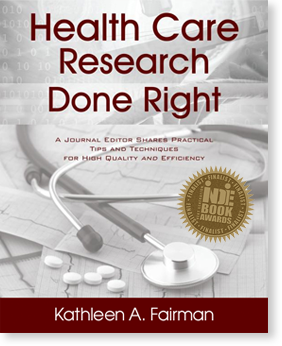
Health Care Research Done Right
High Quality and Efficiency—You Can Have Both!
Are you a health care researcher or student who is long on objectives but short on time? Do you think that you have to choose between “doing it fast” and “doing it right”? Or do you use health care research information but feel unsure about whether it is accurate? This book was designed with your needs in mind. Written in an entertaining style by an experienced journal editor and methodologist, the book is a wealth of practical tips that one reviewer has called “a unique and welcome breath of fresh air.” Learn how to:
• Plan your research well at the start to avoid problems later in the process
• Organize data files to improve accuracy and
save time
• Avoid common mathematical mistakes
• Use health care claims databases effectively by understanding their strengths and limitations
• Conduct a survey that yields valuable information
• Write a publishable article
• Respond appropriately to peer reviewer comments even when they are incorrect
• Assess the quality of research evidence...
and more!